Kosoba Ardia Testing

Mechanism for increasing marketable yield

The improvement in agricultural yield with EF Polymer results from three combined effects: improved water availability, optimized nutrition and enhanced soil structure. Together, these reduce water and nutrient stress, allowing crops to redirect energy toward plant production and significantly increase marketable yield: concrete case on tomatoes in Spain +46% yield

Constant hydration and reduced water stress

Nutrient sequestration: EF Polymer captures and retains soluble nutrients (nitrogen, potassium, phosphorus, etc.) during irrigation or rainfall.
Reduced leaching: nutrients remain available within the root zone instead of infiltrating deeper into the soil or escaping into groundwater.

Nutrients available at the right time

Extended availability: the polymer gradually releases nutrients along with water, ensuring consistent nutrition over several months.
Synchronization with plant needs: inputs are aligned with the plant’s actual growth cycle.

Improved soil structure

Reduced waste: applied fertilizers are used more efficiently by plants, allowing initial doses to be reduced by up to 20%.
Optimized resource allocation: improved water and nutrient availability enables the plant to redirect energy toward fruit production rather than root development.

EF Polymer creates a moist, nutrient-rich, and well-aerated root environment, limiting stress factors and promoting an increase in marketable yield of up to +46% depending on the crop (e.g., tomato).

Scientific justification of water and agronomic gains under semi-arid conditions

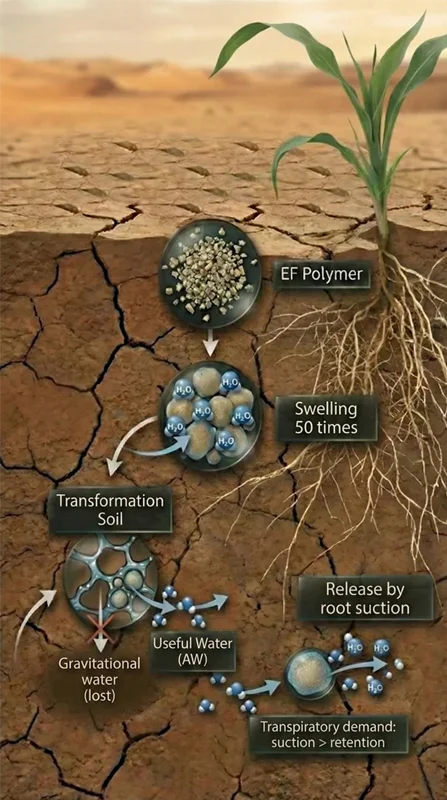
EF Polymer (Eco-Friendly Polymer) is a superabsorbent hydrogel (SAP) of organic and biodegradable origin. Its mode of action is based on three distinct physicochemical principles that explain the observed performance.

Osmotic hydro-retention mechanism

The cross-linked molecular structure of EF Polymer enables the absorption and storage of water molecules (H₂O) within its matrix, reaching up to 50 times its dry weight.

Soil transformation

By integrating into the substrate, the polymer modifies the soil water retention curve (pF), increasing the proportion of plant-available water (PAW) and limiting losses through gravitational drainage.

Release through root suction

Water is not permanently sequestered. The polymer acts as a buffering reservoir. As soil water potential decreases, the stored water is gradually released and made available for root uptake according to the plant’s transpiration demand.

Result

Prolonged maintenance of favorable moisture conditions in the rhizosphere, contributing to optimized resource allocation toward plant production and a significant increase in marketable yield.


Learn more about the benefits of EF Polymer

Up to 20% less fertilizer

By maintaining moisture in the root zone, EF Polymer improves nutrient availability. Fertilizer requirements are reduced by 20% without compromising crop performance.

Up to 40%* water savings

EF Polymer retains water close to the roots and limits losses through infiltration and evaporation. Farmers reduce their water input by a proven 20–25% and up to 40%, depending on crops and soil conditions.

100% biodegradable within 12 months

Unlike synthetic polymers, EF Polymer fully degrades in approximately one year, without microplastics or residues. It improves soil structure and organic matter, making it fully compatible with sustainable agriculture.