Kosoba Ardia Testing

Complementary to drip irrigation and desalinated water

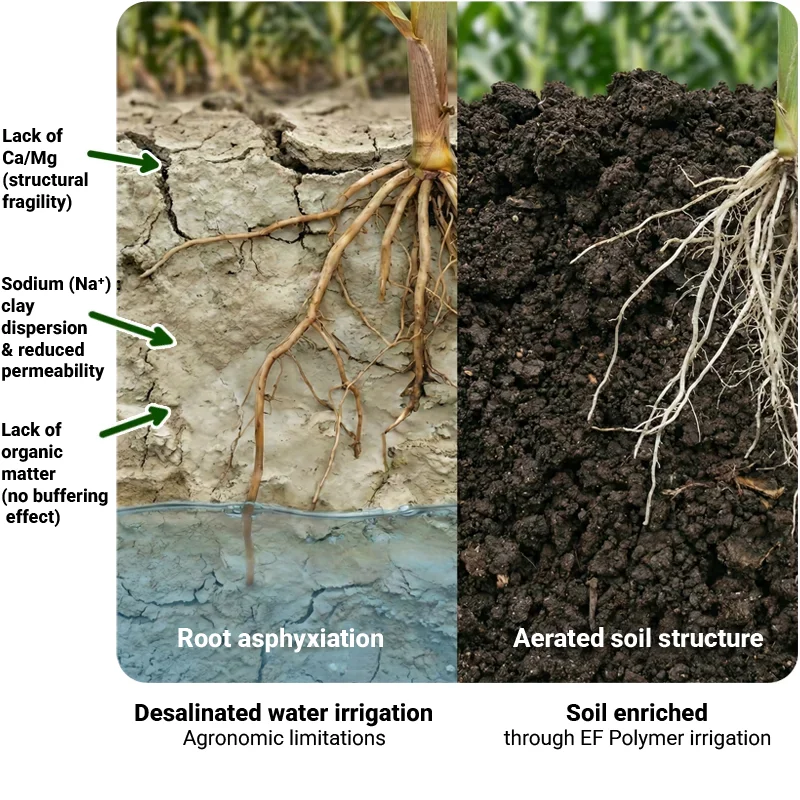
Irrigation with desalinated water helps address water stress, but it gradually weakens agricultural soils by promoting sodification and structural degradation. Without organic inputs, soil permeability decreases, roots become oxygen-deprived, and productivity declines.

EF Polymer helps secure soils over the long term by preserving their structure, biological activity, and hydrological function.

Agronomic limitations of desalinated water irrigation

Even when desalinated water is of good quality, it presents several constraints for soils. Its low calcium and magnesium content weakens structural stability, while the presence of sodium (even at low concentrations) can, over time, cause clay dispersion, reduced permeability, and progressive root system suffocation. In addition, the total absence of organic matter deprives the soil of any biological and structural buffering effect.

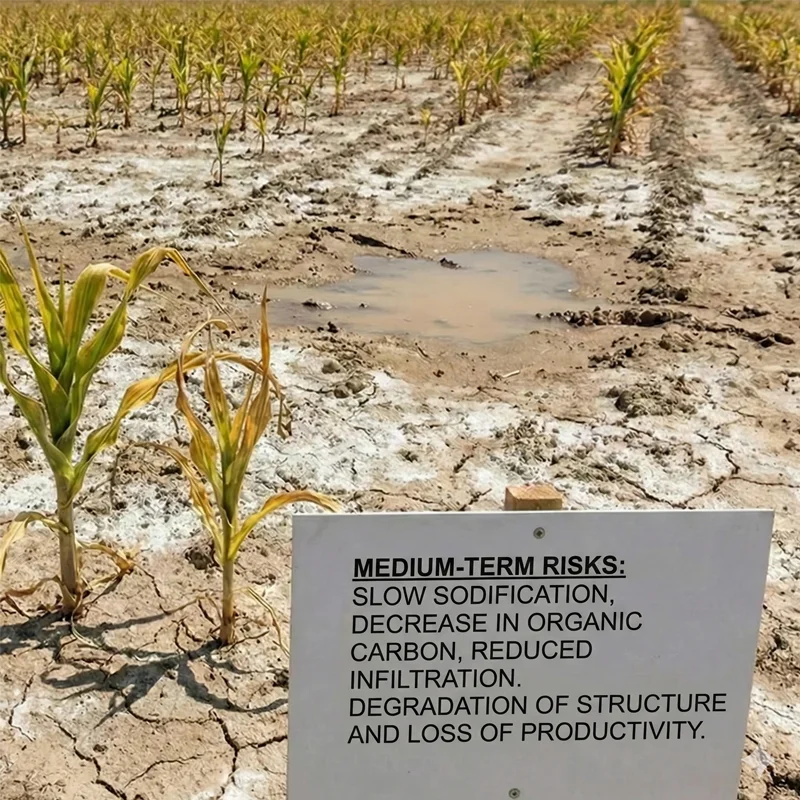
Medium-term risks for agricultural soils

Without corrective action, prolonged irrigation with desalinated water can lead to gradual soil sodification, a decline in organic carbon, and reduced water infiltration. These combined effects result in progressive soil structure degradation and a loss of productivity observable within a few years.

Physico-chemical stabilization and sodium management

EF Polymer provides a source of biodegradable organic carbon in irrigated soils that are typically deficient in it. Its gradual degradation stimulates microbial activity, promotes the production of natural biological binders, and sustainably reinforces soil structural stability while limiting sodium-related imbalances.

Restoration of the biological and organic buffer

Thanks to its water retention capacity, EF Polymer improves water availability in soils weakened by structural degradation. By preserving pore openness and air and water circulation, it prevents root asphyxiation and allows roots to remain active and functional, even under sodic conditions.

Maintaining infiltration and protecting the root system

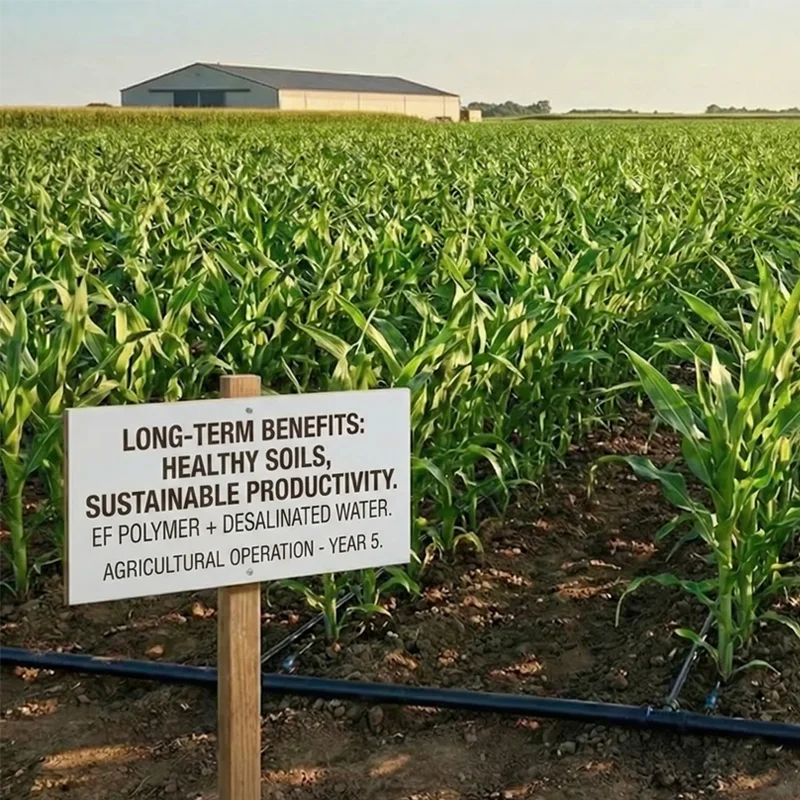
By integrating EF Polymer into irrigation systems using desalinated water, agricultural operations can prevent soil sodification, maintain structural quality, and sustainably preserve productivity, while securing the use of alternative water resources.

Long-term benefits for agricultural operations

By integrating EF Polymer into irrigation systems using desalinated water, agricultural operations can prevent soil sodification, maintain structural quality, and sustainably preserve productivity, while securing the use of alternative water resources.

Optimizing the trio: desalinated water, drip irrigation, EF Polymer

In the water-stressed context of the Souss-Massa region, where irrigation now relies primarily on desalinated water (costly and energy-intensive) delivered through localized systems (drip irrigation), EF Polymer acts as the “missing link” to ensure the agronomic and economic viability of this model.

Learn more about the benefits of EF Polymer

Up to 40% water savings

EF Polymer retains water close to the roots and limits losses through infiltration and evaporation. Farmers can reduce water input by up to 40%.

Up to 15% more growth

Better hydration of the root system leads to more uniform growth and enhanced vegetative development, with up to 15% additional biomass depending on the crop.

Up to 20% less fertilizer

By maintaining moisture in the root zone, EF Polymer improves nutrient availability. Fertilizer requirements are reduced by 20% without compromising crop performance.

100% biodegradable within 12 months

Unlike synthetic polymers, EF Polymer fully degrades within 6 to 12 months, without microplastics or residues. It improves soil structure and organic matter, making it fully compatible with sustainable agriculture.