This optimization allows fertilizer inputs to be reduced by up to 20% while enhancing crop growth and performance.
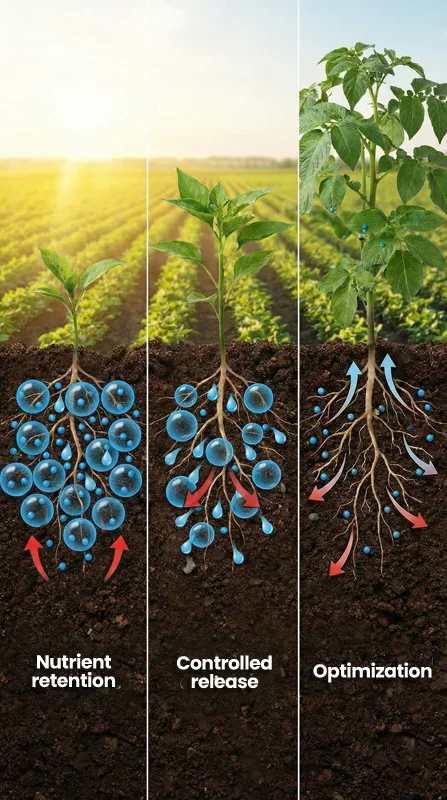
EF Polymer retains nutrients in the root zone and releases them progressively, reducing losses and improving fertilizer efficiency. This optimization allows fertilizer inputs to be reduced by up to 20% while enhancing crop growth and performance.
Nutrient sequestration: EF Polymer captures and retains soluble nutrients (nitrogen, potassium, phosphorus, etc.) during irrigation or rainfall.
Reduced leaching: nutrients remain available near the roots instead of infiltrating deeper into the soil or escaping into groundwater.
Extended availability: the polymer gradually releases nutrients together with water, ensuring consistent nutrition over several months. Inputs are therefore aligned with the plant’s actual growth rate.
Applied fertilizers are better utilized by plants, reducing waste and allowing initial application rates to be reduced by up to 20%.
Enhanced growth improves water and nutrient availability, promoting more uniform development and potentially increasing yields by up to 15%.

In sandy or sandy-loam soils, such as those in the Souss-Massa region, hydraulic conductivity is high.
A large portion of irrigation water is lost through deep percolation (gravitational drainage) before plants can absorb it.
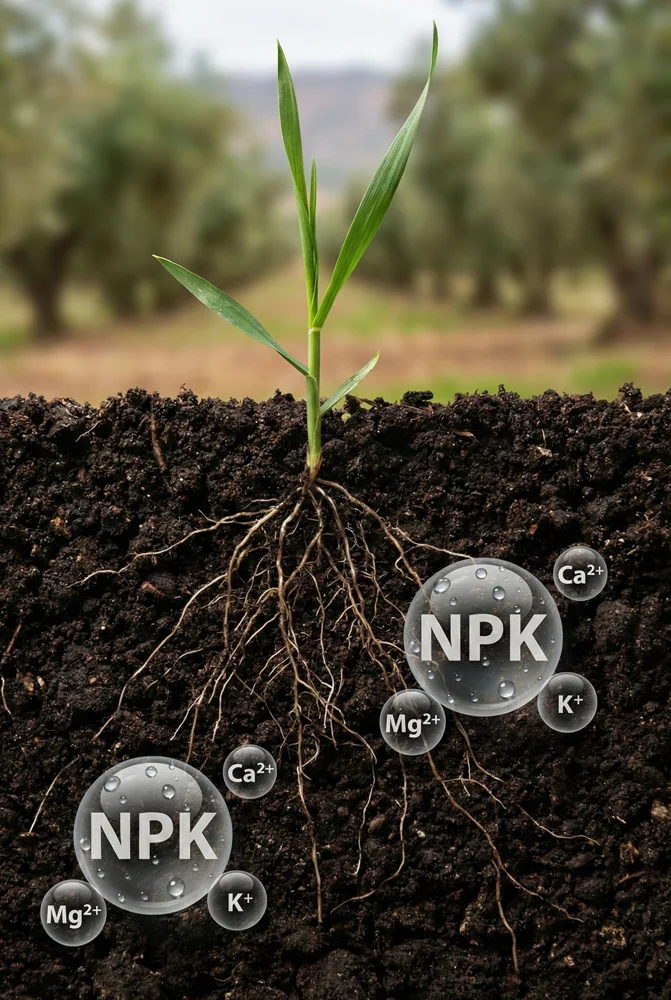
EF Polymer absorbs the soil solution, not just pure water. Dissolved nutrients (N-P-K) are captured within the gel matrix instead of being leached into groundwater.
The polymer’s functional groups (often negatively charged) form temporary bonds with cations (K+, Ca2+, Mg2+), preventing their loss.
The polymer acts as a slow-release distributor. Nutrients remain available in the root zone and are released progressively, ideally matching the plant’s nutrient uptake kinetics.
Maximized fertilizer use efficiency, allowing input rates to be reduced without deficiency.
The use of the polymer optimizes water resource allocation, enabling the plant to redirect energy toward fruit production rather than root development, resulting in significant gains (e.g., for tomatoes: +46% marketable yield).
EF Polymer retains water close to the roots and limits losses through infiltration and evaporation. Farmers reduce their water input by a proven 20–25% and up to 40%, depending on crops and soil conditions.
Unlike synthetic polymers, EF Polymer fully degrades in approximately one year, without microplastics or residues. It improves soil structure and organic matter, making it fully compatible with sustainable agriculture.