Kosoba Ardia Testing

Improvement of soil organic matter (SOM/SOC) and soil revitalization

Nutrient reservoir: soil organic matter (SOM) plays a central role in fertility by contributing to the storage and gradual release of nutrients through natural soil biological processes.

Biological activity and soil biodiversity: SOM serves as an energy source for soil microflora and fauna (bacteria, fungi, earthworms), which are essential for biological functioning, nutrient transformation and soil stability.

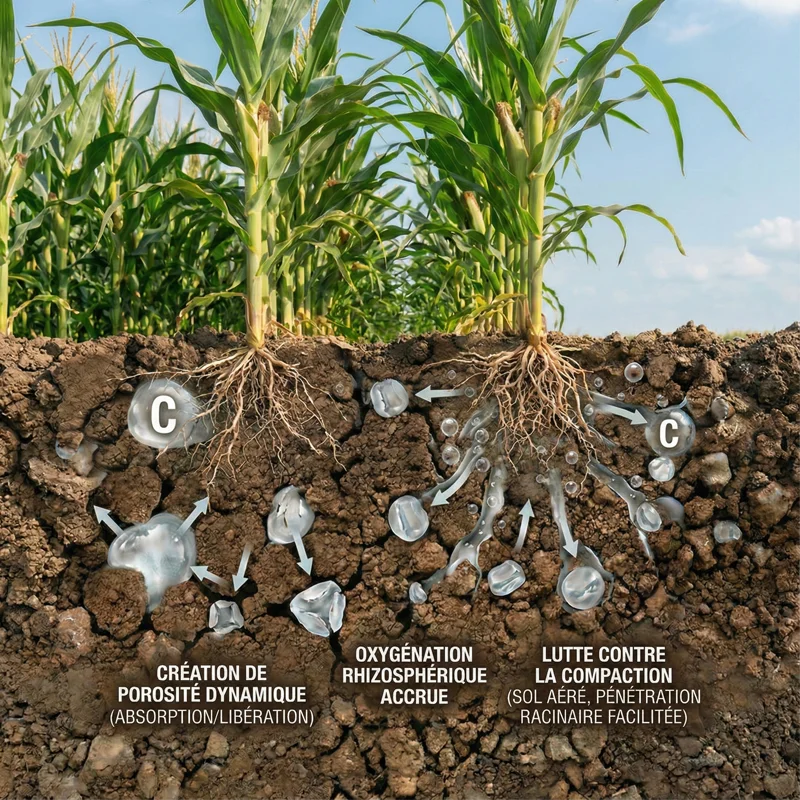
Impact of EF Polymer on the regeneration of arid soils and the carbon balance

Beyond its water management role, EF Polymer acts as an active soil conditioner. In the context of skeletal (sandy) or degraded soils, its application directly contributes to restoring physical fertility and carbon storage, in line with Morocco’s supported objectives.

Physical improvement: the “accordion” effect and porosity

EF Polymer modifies the soil’s physical structure through its mechanical absorption/release cycle:

  • Dynamic porosity creation:
    by swelling (absorption) and contracting (release), the granules exert mechanical pressure on surrounding soil particles. This movement creates and maintains artificial macroporosity.
  • Rhizospheric oxygenation:
    increased porosity promotes air circulation within the soil. A well-aerated soil is essential to prevent root asphyxiation and to support active nutrient uptake (which requires metabolic energy and therefore oxygen).
  • Compaction control:
    in silty or crusting soils, incorporating the polymer reduces soil bulk density, facilitating root penetration and reducing the energy plants must expend to explore the soil.

Transformation into stable humus

During its slow biodegradation, part of the polymer’s carbon does not immediately mineralize into CO2 but undergoes a humification process. It is transformed into stable humic compounds (humic and fulvic acids) that bind to clay particles.

Formation of the clay–humus complex (CHC)

Soil naturally contains active bacterial and fungal microflora. These microorganisms use the polymer’s cellulose and pectin as a carbon source and release specific enzymes that break polymer bonds, converting the gel into simple monomers.

Ongoing trials: Carbon and Salinity (Na⁺)

Additional tests are planned to assess the extent of carbon sequestration in soils resulting from the EF Polymer effect.

The retention and natural removal of sodium (Na⁺) derived from desalinated water.

Biological stimulation: living soil

Water and carbon are two essential factors for microbial life in arid zones.

Microbial refuge

Hydrogel granules, saturated with water and carbon, act as microscopic “oases” for beneficial bacteria and fungi (mycorrhizae, PGPR).

Exudates and aggregation

This stimulation of biological activity leads to the production of glomalin and mucilages (biological binders) by microorganisms, strengthening soil aggregate stability and thereby limiting erosion.

Learn more about the benefits of EF Polymer

Significant additional yield

The use of the polymer optimizes water resource allocation, enabling the plant to redirect energy toward fruit production rather than root development, resulting in significant gains (e.g., for tomatoes: +46% marketable yield).

Up to 20% less fertilizer

By maintaining moisture in the root zone, EF Polymer improves nutrient availability. Fertilizer requirements are reduced by 20% without compromising crop performance.

100% biodegradable within 12 months

Unlike synthetic polymers, EF Polymer fully degrades in approximately one year, without microplastics or residues. It improves soil structure and organic matter, making it fully compatible with sustainable agriculture.

Up to 40%* water savings

EF Polymer retains water close to the roots and limits losses through infiltration and evaporation. Farmers reduce their water input by a proven 20–25% and up to 40%, depending on crops and soil conditions.